
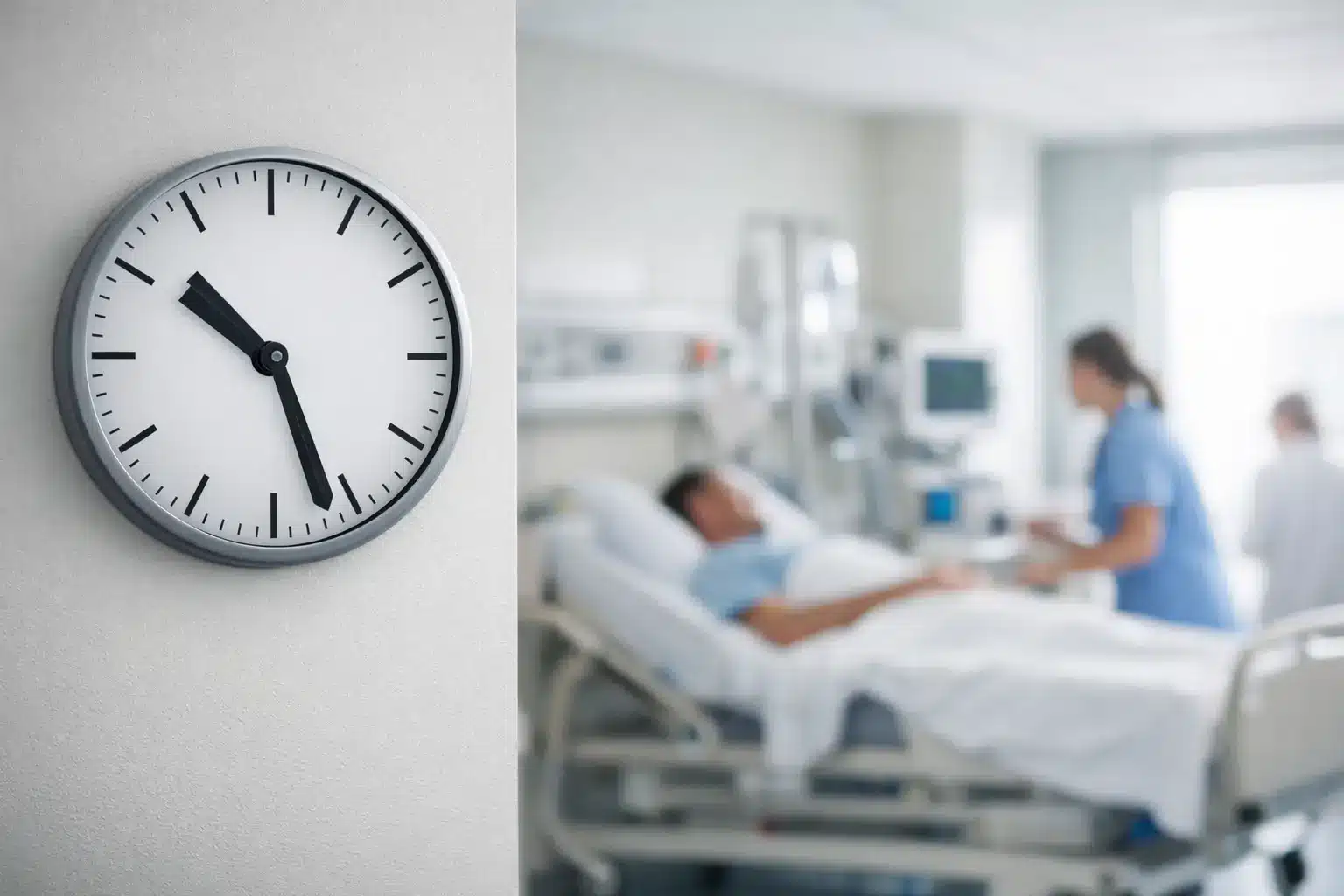
A ward can run on different priorities from one hour to the next: medication rounds, observations, meal service, visiting times, transfers and handovers. If clocks show conflicting times, staff lose a simple but essential point of reference. Clock systems for NHS wards provide a consistent time display across patient areas, nurses’ stations, treatment rooms and circulation spaces, helping teams work to the same schedule.
For estates and facilities teams, the requirement is not simply to fit more clocks. It is to specify a timekeeping system that is visible, dependable, practical to maintain and suited to the hospital’s infrastructure. The right answer will vary between a single ward refurbishment and a multi-building hospital project.
Why accurate ward timekeeping matters
Time is a working tool in a clinical environment. It supports the routine coordination of care and enables staff to record events accurately. A clock at a nurses’ station may be referenced during a handover; a highly visible display in a bay allows staff to check the time without leaving a patient; clocks in corridors and waiting areas help patients, visitors and portering teams orientate themselves.
The problem with independently set battery clocks is gradual drift. A few minutes of difference between a ward clock, a treatment room clock and the time shown on a workstation can create avoidable confusion. Seasonal clock changes also create a maintenance task across a large estate, with the risk that some units are missed.
A synchronised system addresses this by driving every connected clock from a common, reliable time source. Once installed and configured correctly, the displayed time remains aligned across the defined area or site. This is particularly valuable where staff move between departments or where the same operational timetable applies across several wards.
Clock systems for NHS wards: the main options
There is no universal system type for every hospital. Building age, ceiling construction, cable routes, existing network capacity, clinical programme and future expansion all affect the most suitable specification. The principal options are wired, wireless, WiFi and Power over Ethernet systems.
Wired synchronised clocks
A wired clock system uses dedicated cabling to distribute time from a central controller or master clock. It is a sensible choice during new-build projects, major refurbishments or works where containment and cable routes are already being installed.
Its principal benefit is a fixed, controlled connection. For large installations, this can provide a highly dependable basis for synchronisation without relying on radio coverage or local wireless conditions. The trade-off is installation complexity. Retrofitting cables into a live ward environment can involve more disruption, access planning and cost than other approaches.
Wireless clock systems
Wireless synchronised clocks receive time from a master transmitter or controller, removing the need for a cable to each clock position. This can be particularly useful for refurbishment work, older buildings and phased installations where opening walls or ceilings is undesirable.
Coverage must be assessed rather than assumed. Dense construction, reinforced concrete, plant rooms, lift shafts and the layout of a large hospital can affect signal performance. A proper survey considers the proposed transmitter location, ward geography and any areas likely to sit at the edge of coverage. In some cases, additional transmitters or repeaters may be required.
WiFi clock systems
WiFi clocks connect through the organisation’s existing wireless network and synchronise through approved network time services. They can suit sites with well-managed WiFi infrastructure and can be easier to extend across buildings where wireless coverage is already established.
This approach needs early engagement with IT. Network access, device management, security requirements, IP addressing and the availability of a trusted time source all need agreement before equipment is selected. WiFi is not automatically the lowest-cost route if the required wireless coverage is weak or unavailable in the precise areas where clocks are needed.
PoE clock systems
Power over Ethernet, usually shortened to PoE, combines power and network connectivity through a single structured data cable. PoE clocks are often specified where network cabling is available or planned and where a facilities team wants a network-managed solution without local power supplies.
They are well suited to planned construction and refurbishment projects, but the network design matters. Switch capacity, available PoE budget, port allocation and resilience arrangements should be reviewed with the IT team. If network equipment is supported by an uninterruptible power supply, that may also be relevant to the clock system’s continuity arrangements.
Specify visibility before selecting the technology
Synchronisation is only one part of the brief. A clock that is accurate but hard to read does not solve the operational problem. Clock position, display size, contrast and viewing distance should be considered room by room.
Analogue clocks remain a practical choice for many ward bays, day rooms, corridors and reception points. Their familiar face can be read quickly at a glance, including from a distance. Large, clear numerals and a suitable dial colour can improve legibility under typical ward lighting.
Digital LED clocks are often preferable where a precise numeric readout is required, particularly at nurses’ stations, in treatment areas or in locations where seconds may be operationally useful. The display should be sized for the actual viewing distance, not simply selected from a catalogue image. Brightness also requires consideration: a display intended for a public concourse may be unsuitable if it causes glare or distraction in a low-light clinical setting.
Clock mounting is equally important. A single-sided wall clock may be sufficient in a bay, while a double-sided corridor clock can be read from either direction. Avoid placing clocks where privacy curtains, door positions, signage, clinical equipment or high-level service installations block the sightline.
Plan for the ward environment
NHS wards are demanding environments. Equipment must be capable of routine cleaning and should be selected with infection prevention and control requirements in mind. Smooth, accessible surfaces and suitable housing make planned cleaning more straightforward, while clock location should avoid creating unnecessary dust traps or inaccessible areas.
The system should also reflect how the ward operates. Patient-facing areas usually need clear, calm time displays, whereas staff-only spaces may require a more detailed digital format. Not every location needs seconds, and adding them everywhere can create visual clutter without an operational benefit.
For dementia-friendly or older persons’ wards, a large analogue clock with clear numerals may be more helpful than a compact digital display. In contrast, higher-acuity settings may need a display that makes hours, minutes and seconds immediately legible. The best design is based on the users and tasks in each space, not a one-size-fits-all standard.
Questions to resolve during specification
A clear brief avoids late changes and ensures the selected system can be installed without compromising the ward programme. Before placing an order, project teams should establish:
- which rooms, corridors and shared spaces require clocks, including future expansion areas;
- whether the installation is a new build, refurbishment or live-environment retrofit;
- the preferred time source and the level of resilience required if network or power services are interrupted;
- whether IT approval is needed for WiFi or PoE devices;
- the required display type, viewing distance, mounting arrangement and need for seconds;
- cleaning, access and maintenance requirements; and
- who will own routine checks, battery replacement where applicable, and changes to system settings.
It is also worth identifying interfaces with other project disciplines early. Ceiling plans, containment routes, wireless access points, electrical drawings and fire compartmentation can all affect the installation. A clock system may be a relatively small package within a ward scheme, but late coordination can still lead to compromised locations or avoidable disruption.
Central control and future maintenance
The value of a synchronised system is not limited to the day it is commissioned. Central control reduces the need for manual adjustment at individual clocks and supports a more consistent approach to British Summer Time changes. It also makes it easier to add clocks as wards are altered, extended or repurposed.
However, a system should be proportionate. A small ward with limited clock positions may not need the same architecture as a large acute hospital campus. Conversely, choosing standalone clocks purely to reduce initial spend can introduce ongoing maintenance work and inconsistent timekeeping across a wider site. The right balance depends on the scale of the estate, infrastructure already in place and the operational cost of managing separate clocks.
Clock Systems Service Ltd supports project-led clock specifications, from visible analogue and LED displays to wired, wireless, WiFi and PoE synchronised systems. A site-led assessment allows clock locations, technology and maintenance requirements to be considered together rather than treated as separate purchasing decisions.
A well-specified ward clock system should fade into the background because it simply works: every display is clear, every area shows the same time, and staff can concentrate on the work in front of them.