
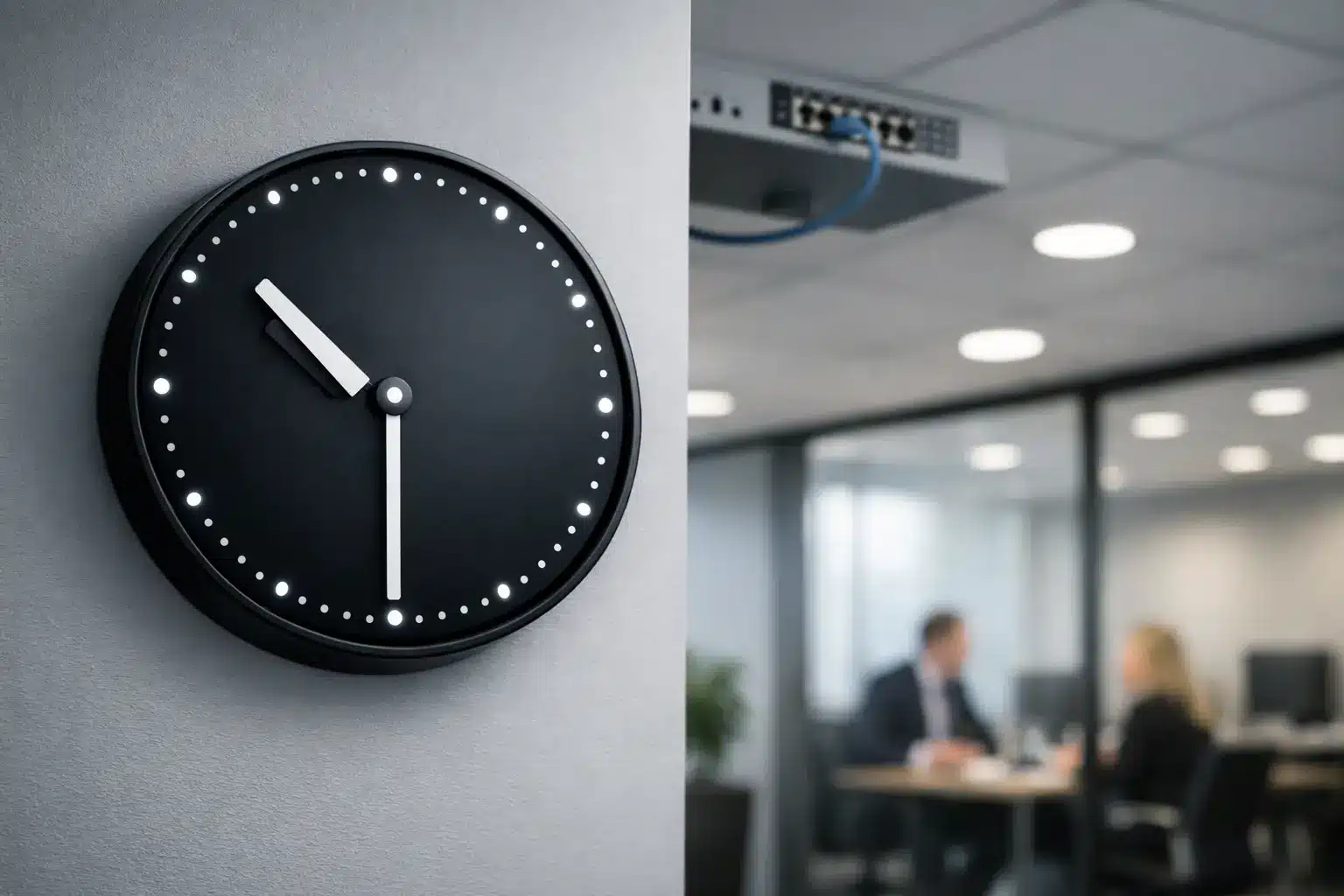
A clock that is five minutes wrong can be a nuisance in an office. In a hospital ward, school corridor, warehouse dispatch area or transport facility, it can affect handovers, timetables, safety checks and public confidence. PoE clocks give organisations a practical way to place accurate, synchronised time displays where they are needed, using the existing structured network cabling.
For facilities teams and project managers, the attraction is straightforward: one cable can supply both power and network communication. The clock receives its time from a defined source, displays it clearly, and can be managed as part of a wider synchronised time system. However, PoE is not automatically the right answer for every building. Network capacity, cable routes, mounting locations and the number of clocks all need to be considered before a specification is finalised.
What are PoE clocks?
PoE clocks are network-connected clocks powered through Power over Ethernet. Rather than requiring a local mains socket or regular battery changes, each clock connects to a compatible PoE network switch or injector via Ethernet cabling. The same connection provides electrical power and allows the clock to receive synchronised time.
In a correctly designed system, the clocks reference a common time source, typically through Network Time Protocol (NTP). This means clocks across a site can display the same time without manual adjustment. Daylight saving changes can also be applied centrally, avoiding the familiar task of walking through a building twice a year to alter individual clocks.
PoE clock systems can include analogue clocks, LED digital clocks and information displays, depending on the required viewing distance and environment. A corridor may suit a large analogue dial, while a production floor or reception area may need a bright LED display that remains legible across a larger space.
Why organisations choose PoE clock systems
The principal benefit is controlled consistency. When staff, visitors and service users rely on time, every visible clock should agree. A synchronised PoE system reduces discrepancies caused by depleted batteries, manually set clocks or isolated devices that have not adjusted correctly following a power interruption.
PoE also simplifies installation in locations where mains power is inconvenient or expensive to provide. If a network point can be installed at the required clock position, a separate electrician’s supply may not be necessary. This can be particularly useful for new-build projects, refurbishments and sites with suspended ceilings, long corridors or numerous wall-mounted displays.
For estates and IT teams, the technology offers clearer system oversight. Network-connected clocks can be planned alongside switches, cabinets, cable runs and resilience requirements. This does not remove the need for proper coordination between trades, but it gives the project a defined infrastructure model rather than a collection of independent clocks.
There is also a maintenance advantage. Battery clock estates can be economical at small scale, but replacing batteries across dozens or hundreds of units creates an ongoing task and introduces opportunities for inconsistent time. A PoE installation moves the focus from local battery maintenance to managed network infrastructure.
Specifying PoE clocks for your building
A successful specification starts with the operational requirement, not the clock style. The first questions are where time must be seen, who needs to read it and what action depends on it. A clock above a school hall entrance has different visibility requirements from one in an operating department, loading bay or railway concourse.
Visibility, viewing distance and display type
Clock size should be selected according to viewing distance, lighting conditions and the amount of information on display. Analogue clocks are familiar and quick to interpret in classrooms, waiting areas and corridors. LED digital clocks provide strong visibility over distance and can be a better fit for warehouses, sports facilities, transport environments and clinical spaces where precise digital time is preferred.
Consider the mounting orientation as well. A single-sided wall clock may be adequate for a narrow corridor, whereas a double-sided clock can serve open circulation areas, reception spaces and long passageways. Ceiling mounting, protective housings and high-contrast faces may be required where a standard wall installation would be difficult to read or vulnerable to damage.
Power and network compatibility
The network must be capable of delivering the required PoE standard and power budget to every clock location. This is an essential check, particularly on larger sites where switch capacity is shared with wireless access points, telephony, security equipment or other powered devices.
Cable lengths and routes also matter. Ethernet runs are subject to recognised distance limits, so remote buildings, external spaces and unusually large industrial sites may require additional network equipment or a different time-distribution method. Early discussion between the clock supplier, IT department, electrical contractor and principal contractor avoids late changes to containment or cabling.
Where continuity of time display is critical, the resilience of the wider network should be reviewed. A clock may retain time during a short network interruption, but the behaviour of the complete system should be understood. Switch power, uninterruptible power supplies, network segmentation and the availability of the nominated time source can all affect operational performance.
Time source and cybersecurity
A synchronised time system needs a reliable reference. The preferred method depends on the site and its network policy. Some organisations use an internal NTP server, while others take time from a controlled external source. Critical environments may require a dedicated time appliance or additional resilience so that timekeeping does not depend on a single connection.
Because PoE clocks sit on a network, they should be included in normal IT governance. This includes allocating appropriate network access, reviewing device configuration, applying approved security controls and documenting ownership. A commercial clock installation should support the organisation’s technical standards rather than becoming an unmanaged exception.
Where PoE clocks are most effective
Healthcare settings are a common application because consistent time supports staff coordination, appointments, clinical routines and shift changeovers. Different areas may require different clock types: clear analogue displays in public spaces, larger digital clocks in treatment areas and highly visible units in staff work zones.
Schools, colleges and universities benefit from a single time standard across classrooms, corridors, sports halls and administration areas. Reliable synchronisation helps lessons start consistently and reduces the practical disruption caused by individual clocks drifting apart.
In warehouses and manufacturing environments, time displays often need to be read quickly from a distance. Large LED PoE clocks can support shift changes, break schedules, dispatch deadlines and production coordination, provided the display is specified for the ambient light, dust exposure and viewing angles on site.
Transport, leisure and public buildings also place a premium on clear, dependable time. Here, clock positioning and appearance are as important as the underlying technology. The system must be easy for the public to read while remaining suitable for high-traffic areas and day-to-day facilities management.
PoE, WiFi or wireless clocks?
PoE is a strong choice where structured cabling is available, network management is acceptable and the organisation wants powered, connected displays without batteries. It is often particularly suitable during construction or major refurbishment, when cable routes can be planned before finishes are complete.
WiFi clocks can reduce cabling requirements, but still need a local power source unless battery-operated. Their suitability depends on reliable wireless coverage, network policy and the environment. They can be useful where installing new Ethernet cable would be disruptive.
Dedicated wireless synchronised clock systems are often preferable for existing estates, heritage buildings or sites where network access is restricted. Battery-powered wireless clocks can be quicker to deploy across many rooms, although they require planned battery replacement and use a separate radio infrastructure.
There is no universal winner. A small office with a handful of clocks may be well served by quality quartz units. A multi-building campus may use a combination of PoE, wireless and LED displays, selected according to each area’s infrastructure and operational need.
Installation considerations that prevent later problems
Clock locations should be agreed using drawings and site surveys, not assumed from a schedule alone. Door openings, ceiling features, daylight glare, racking, signage and future partitions can all compromise visibility. It is better to adjust a mounting position before cabling is installed than after a clock has been commissioned.
The specification should also state whether clocks are surface-mounted, flush-mounted, suspended or double-sided, together with cable termination responsibilities. In commercial projects, uncertainty over who provides containment, data outlets, patching and switch ports is a common cause of delay.
Commissioning should confirm that every display receives the correct time, follows the intended daylight saving settings and is visible from the required positions. Record the clock locations, network details and time-source arrangement so that facilities and IT teams can support the system after handover.
Clock Systems Service Ltd works with organisations that need timekeeping designed around the building and its operation, rather than selected from a catalogue in isolation. The most useful next step is to map the areas where accurate time genuinely affects people, process or safety, then choose the clock and synchronisation method that will remain practical for the life of the site.